
In this Article

By: All Allied Health Staff
Updated: March 23, 2026
Dental lab technician overview
What is a dental lab technician?
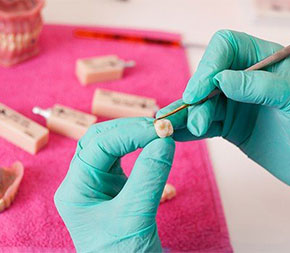
A dental lab technician plays a crucial role in creating dental appliances like crowns, bridges and dentures. They utilize impressions or molds of patients’ teeth to fabricate these custom-made dental devices. While working closely with dentists, dental lab technicians have limited direct contact with patients, focusing primarily on the precise craftsmanship and technical skills required for producing high-quality dental restorations. Often mistakenly confused with dental hygienists, they are however distinct, each skilled in their separate and specialized trade.
What do dental lab technicians do?
Using a dentists’ detailed written directions, and molds of a patient’s teeth or oral soft tissues, dental lab technicians make the following items:
Dental lab technicians can also specialize in one of five areas: orthodontic appliances, crowns and bridges, complete dentures, partial dentures and ceramics.
“Dental technicians work with a variety of materials including waxes, plastics, precious and non-precious alloys, stainless steel, a variety of porcelains, and composites or polymer glass combinations. Many technicians skillfully use sophisticated instruments and equipment. It is important for the technician to help create tooth replacements that are both attractive and functional,” says the American Dental Association (ADA).
What education do dental lab techs need?
Although each program has unique entry requirements, a high school diploma or GED is a standard prerequisite for applying to an accredited dental lab technology program.
Some dental technicians begin careers without a college degree, but you’ll find it’s easiest to start your career by pursuing formal training through an accredited program. There are two-year dental lab technician programs leading to an associate’s degree or certificate, and a few four-year bachelor’s programs are also available. These programs are offered at community colleges, vocational schools, technical colleges, universities and dental schools. Dental lab technology programs should be accredited by the Commission on Dental Accreditation (CODA).
Some dental lab techs also start off as a dental assistant and pivot into the field of dental technology.
In addition to formal training, the following skills will serve you well in your dental technician career:
Do dental lab techs need a license or certification?
There is no license required for dental lab technicians, but optional certification is available. Certification recognizes a dental lab technician’s knowledge and technical skills. It involves passing an exam administered by the National Board for Certification in Dental Laboratory Technology. In order to take the certification exam, you must have completed an accredited dental laboratory technology program and have had two years of professional experience, or, if you’ve been trained on the job or through a non-accredited program, you can take the exam after five years of work experience as a dental lab technician. Upon passing the exam, you become a Certified Dental Technician (CDT).
Median annual dental lab technician salary
According to the 2024 Occupational Employment and Wage Statistics from the BLS, the median annual salary for dental lab technicians is $48,310.
Check out the median annual salaries by state below:
Frequently asked questions (FAQ)
How is a dental lab technician different from a dental hygienist?
Dental lab technicians work behind the scenes crafting dental appliances in a lab, while dental hygienists work directly with patients performing cleanings, preventive care and oral health education in dental offices.
What kind of education or training do you need to become a dental lab technician?
Most entry-level positions require at least a high school diploma or GED and completion of a dental laboratory technology program at a vocational school, community college or technical college, typically lasting one to two years and resulting in a certificate or associate degree. Some employers may provide on-the-job training for people with dental assisting experience as an alternative.
What are the job prospects for dental lab technicians?
“The services performed by dental technicians will always be needed. With the population growing older, there will be a continued demand for prostheses which improve these individuals’ nutrition, appearance and ability to speak clearly,” the ADA says. While demand depends on your region and experience, skilled dental lab technicians are needed to support growing restorative and cosmetic dental procedures. Opportunities also exist in management, education and sales.
How is technology impacting the dental lab technician role?
Digital scanning, CAD/CAM design and 3D printing are increasingly important in dental labs. These tools can make the process more efficient and precise, but hands-on craftsmanship and detailed knowledge of dental materials remain essential.
Is certification required to become a dental lab technician?
Certification is optional but highly beneficial. Passing exams from the National Board for Certification in Dental Laboratory Technology earns you the Certified Dental Technician (CDT) credential, which can increase job opportunities and demonstrate advanced skills.